

Why screw loosening is a critical issue in industrial assemblies
In the design and maintenance of bolted joints, one of the most common problems in industrial environments is unwanted screw loosening. This phenomenon occurs especially in applications subjected to vibration, dynamic loads, repetitive operating cycles, or periodic maintenance. To address this reality, NBK has incorporated a nylon patch finish (nylon patch) into several screw families—an integrated locking solution that improves assembly reliability without adding complexity to the installation process.
The risk of loosening in fasteners without locking systems
Under real operating conditions, the initial tightening of a standard screw can lose effectiveness over time. Vibration, movement, and temperature variations promote progressive back-off even when assembly is performed correctly. This leads to clearances, re-tightening, and corrective maintenance, as well as potential safety risks and downtime in automation, instrumentation, and industrial machinery applications.
In sectors such as automation, instrumentation, and industrial machinery, these effects directly impact process reliability and operational continuity.
Why industrial applications need a reliable anti-loosening solution
Faced with these issues, many industrial applications require anti-loosening solutions that are effective, consistent, and easy to integrate. Traditional solutions such as chemical thread lockers or additional locking elements can be functional, but they also introduce extra assembly steps, waiting times, or process variability.
In this context, the use of screws with locking integrated directly into the thread represents an especially attractive alternative for applications where reliability and repeatability are critical.
What is a nylon patch and how does it work?
The nylon patch is a polymeric material patch applied directly to the screw thread, typically made of Nylon 11. During tightening, this material deforms in a controlled manner when it comes into contact with the female thread, generating additional friction that resists reverse rotation of the screw.
Unlike chemical thread lockers, this system does not rely on chemical reactions or post-assembly processes. The anti-loosening effect is achieved at the moment of tightening, in an immediate and repeatable way. NBK screws with nylon patch suppress screw back-off after assembly and help maintain tightening torque in applications subjected to vibration. In many models, the reference temperature range of the patch reaches approximately 120 °C, an important factor to consider during selection.
Key benefits of the nylon patch in industrial applications
The main benefit of the nylon patch is the effective reduction of loosening under dynamic conditions, resulting in more stable and reliable joints over time. As an integrated solution, it does not require additional components or changes to the assembly design.
From a process perspective, assembly is cleaner and more controlled, as no liquid products are used and no additional variables are introduced. Furthermore, screw performance is consistent across repeated assemblies, which is especially valuable in production lines, repetitive maintenance tasks, or precision applications.
Another key advantage is that this system can be applied to compact, low-profile, or miniature fasteners, where other anti-loosening solutions are not feasible due to space constraints.
NBK screw type with nylon patch
NBK has incorporated the nylon patch into various screw families to cover a wide range of requirements, including:
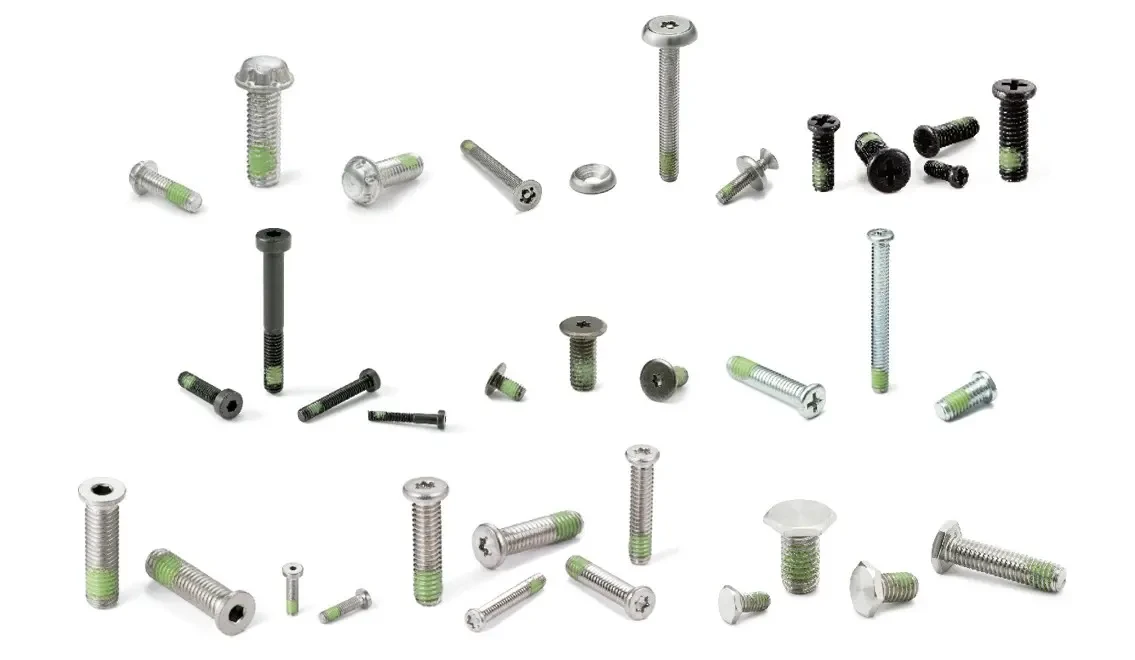
- Low-profile and ultra-low-profile screws
- Screws with 5- or 6-lobe drives
- Miniature screws
- Cylindrical head screws with hex socket (Allen type)
- Flat pan head screws
- Hexalobular screws
Nylon patch vs other anti-loosening methods
Compared to chemical thread lockers, the nylon patch provides immediate locking with no waiting time and no residue, enabling faster commissioning after assembly. Compared with lock washers, it eliminates the need for additional components and reduces the risk of assembly errors. And unlike self-locking nuts, it can be used directly in blind holes or assemblies without a nut.
Overall, the nylon patch stands out for its simplicity, cleanliness, and reliability, especially in applications involving small fasteners or repetitive assembly processes.
Applications where nylon patch screws improve reliability and safety
The use of NBK screws with nylon patch is particularly relevant in:
- Automation machinery
- Equipment with continuous vibration
- Conveyor and transport systems
- Industrial instrumentation
- Applications where periodic maintenance requires clean and controlled disassembly
In these environments, the integrated locking feature helps improve safety, process stability, and the service life of the bolted joint.
As an official NBK distributor, Lindis offers these solutions to help improve the reliability of your equipment. Our team can advise you on selecting the most suitable model according to the application, operating environment, and process requirements.