

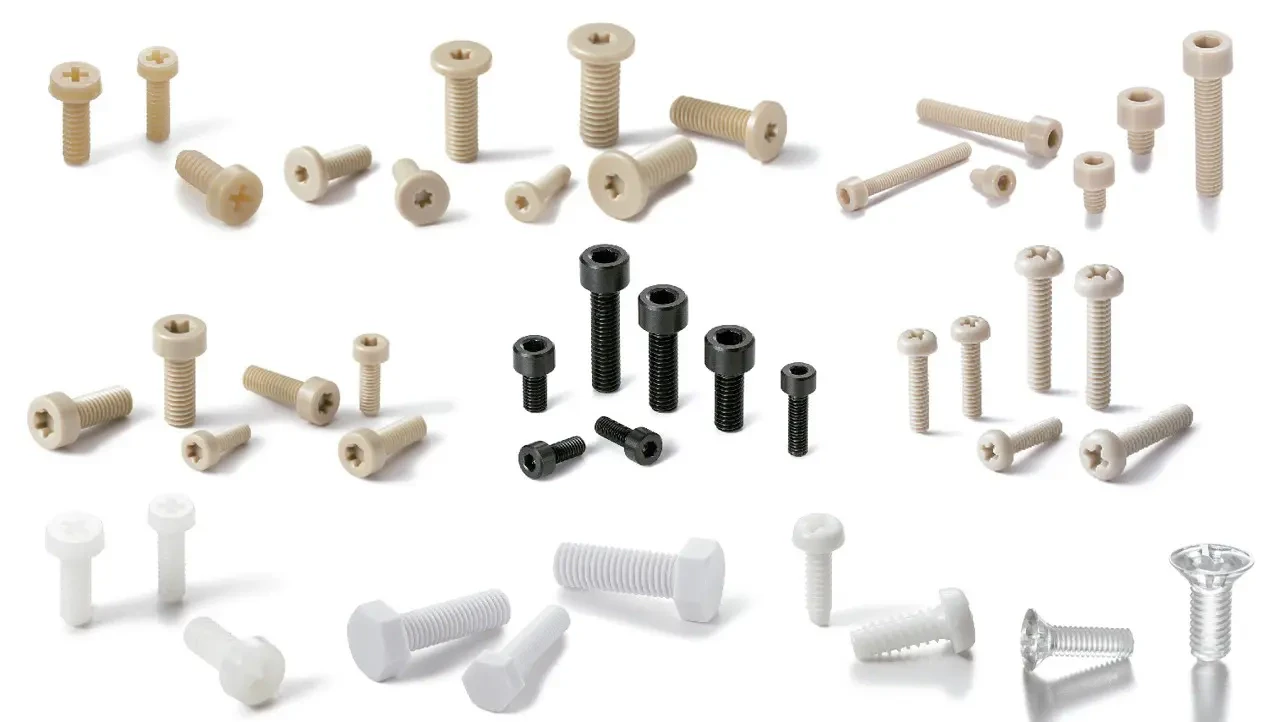
In modern industrial applications—from automation to process equipment—the selection of suitable fastening elements is essential to ensure performance and reliability. NBK has expanded its range of engineering plastic screws, a development that responds to the growing demand for lightweight, corrosion-resistant solutions with specific functional properties. This expansion includes a wide variety of materials and designs, providing technical alternatives to traditional metal fasteners in challenging environments.
This article explores in detail what these new models are, what benefits they provide, and how to select the right plastic screw according to the application.
What are industrial plastic screws?
Plastic screws are fastening elements manufactured from selected engineering polymers that offer characteristics different from metal fasteners. Unlike metals, plastics can provide electrical insulation, inherent chemical resistance, corrosion immunity, and structural lightweight design, making them attractive solutions across many industrial sectors.
NBK classifies its new plastic fasteners within its “Special Screws” catalog, with models designed for demanding environments where material properties are a critical factor.
Main plastic materials and their key properties
The NBK plastic screw range uses high-performance engineering polymers selected for their thermal, chemical, and mechanical properties, allowing each fastener to be matched to very specific operating conditions.
PEEK stands out for its balance of high-temperature resistance, chemical resistance, and wear durability, making it suitable for highly demanding applications. PTFE is intended for environments where chemical resistance and low friction are critical, while PPS offers a solid compromise between thermal stability and chemical resistance in demanding industrial applications.
In addition, NBK incorporates other technical plastics such as RENY, focused on higher mechanical strength; PC (polycarbonate), valued for its impact resistance and electrical insulation; PVC, suitable for chemically aggressive environments at moderate temperatures; PVDF, offering excellent chemical resistance with higher rigidity than PTFE; and VESPEL, designed for extreme applications requiring mechanical stability and wear resistance at high temperatures.
Technical advantages of plastic fasteners
- Corrosion resistance and chemical performance. One of the main benefits of plastic screws is their inherent resistance to corrosion and aggressive chemicals, eliminating the need for external anti-corrosion treatments in many applications.
- Electrical insulation. Unlike metal fasteners, plastic materials are good electrical insulators, a particularly valuable feature in electronic and electrical equipment.
- Lightweight design. The lower density of plastics helps reduce the overall weight of structures and equipment without compromising mechanical functionality within specific load ranges.
- Thermal properties. Certain materials such as PEEK and PPS maintain structural integrity over wide temperature ranges, making them suitable for high-temperature applications.
Criteria for selecting NBK plastic screws
To correctly select an NBK plastic screw, it is important to consider:
- Chemical environment: choose a material compatible with the media present (acids, alkalis, solvents).
- Operating temperature: evaluate the expected thermal range and match it to the temperature capabilities of the selected material.
- Mechanical load: size the screw according to the static and dynamic loads of the assembly.
- Electrical or insulation requirements: for electronic applications, prioritize polymers with low electrical conductivity.
Key applications
NBK plastic screws are used in industrial sectors where their properties deliver clear advantages:
- Chemical processing and industrial plants with corrosive environments.
- Electronic and electrical equipment requiring electrical insulation.
- Pharmaceutical and food industries, where non-metallic materials are preferred due to regulations or design requirements.
- Lightweight machinery and small devices, where weight reduction is beneficial.
The expansion of NBK’s plastic fastener range provides engineers and technicians with a powerful tool to address design and operational challenges in demanding environments. Thanks to the wide variety of materials and fastener formats offered by NBK, it is possible to achieve fastening solutions tailored to very specific applications, combining chemical resistance, electrical insulation, and superior thermal performance.
For technical advice on selecting the most suitable screw type, as well as availability on request, please contact our technical office.