


FDA-compliant reinforced monolithic belts: the hygienic and stable solution for food conveying
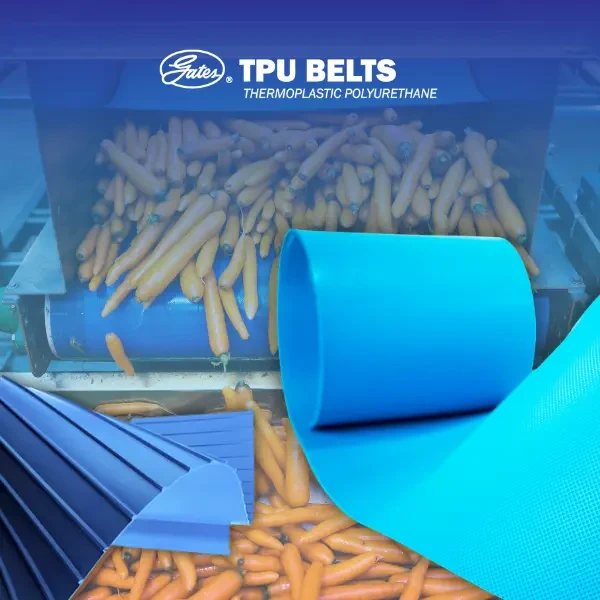
In today’s food industry, conveyor systems are a critical asset to ensure food safety, operational efficiency and production continuity. Among the most advanced solutions on the market are reinforced monolithic (or homogeneous) conveyor belts suitable for food contact in accordance with FDA regulations, a technology designed to meet the hygiene, load and stability requirements of modern processing lines.
In this article we explain what reinforced monolithic belts are, their benefits compared to non-reinforced monolithic belts, their main applications, and why leading brands such as Gates have become a benchmark for this type of solution.
What is an FDA-compliant reinforced monolithic belt?
A monolithic belt is a conveyor belt manufactured from a single piece of thermoplastic material, typically polyurethane (TPU). Unlike traditional multi-ply belts, it does not include fabric layers or textile plies, which helps eliminate risks of delamination, moisture absorption or contaminant retention.
When the belt is also reinforced, it incorporates tensile members (typically aramid cords) fully encapsulated within the belt body. This reinforcement delivers greater dimensional stability, reducing elongation under load and throughout the belt’s service life.
FDA (Food and Drug Administration) compliance and, in many cases, European food-contact regulations, help ensure the material is suitable for use in food production processes, supporting HACCP plans and sanitation audits.
Key benefits of reinforced monolithic belts
1. Maximum hygiene and easy cleaning
The homogeneous, non-porous TPU structure prevents the build-up of product residue, moisture or bacteria. This results in:
- Faster, more effective cleaning
- Lower consumption of water and chemical products
- Reduced risk of cross-contamination
They are particularly well suited for lines with frequent or aggressive washdowns.
2. Lower elongation and higher dimensional stability
Thanks to the internal reinforcement, these belts offer:
- Very low elongation under continuous loads
- Less need for re-tensioning
- Improved tracking and guidance on the conveyor
This translates into fewer unplanned stoppages and higher line OEE.
3. Longer service life and lower total cost of ownership (TCO)
Although the initial investment may be higher than for a non-reinforced monolithic belt, the return is clear:
- Fewer maintenance interventions
- Fewer replacements
- Higher long-term reliability
4. Chemical and mechanical resistance
Reinforced TPU monolithic belts are designed to withstand:
- Fats and oils
- Cleaning and disinfection agents
- Abrasion and demanding loads
Reinforced vs. non-reinforced monolithic belts
Reinforced monolithic belts
- Very low elongation
- Ideal for high loads and long conveying distances
- Greater stability under temperature and humidity changes
- Less maintenance and longer service life
Non-reinforced monolithic belts
- Greater elasticity
- Suitable for short runs or moderate loads
- Lower upfront cost
- Greater need for tension adjustments
The right choice always depends on the specific application, but in critical lines or high-demand environments, the reinforced option is usually the most cost-effective in the medium and long term.
Typical monolithic conveyor belts applications in the food industry
FDA-compliant reinforced monolithic belts are widely used in:
- Meat and poultry: wet environments, fats, intensive cleaning
- Fish and seafood: resistance to moisture and chemicals
- Dairy: high hygiene standards
- Bakery and pastry: dimensional stability and product release
- Fruit and vegetables (fresh-cut / IV range): washing, sorting and conveying
- Confectionery and snacks
They are also a highly valued solution in non-food industries with strict hygiene requirements, such as pharmaceutical and cosmetics.
Gates reinforced monolithic belts: proven performance
At Lindis, we work with Gates reinforced monolithic belts, a globally recognized brand known for innovation and reliability in power transmission and conveying systems.
Gates solutions for food applications stand out for:
- Manufactured in TPU suitable for food contact
- Designs focused on sanitation and efficient cleaning
- Aramid-reinforced versions to minimize elongation
- Greater stability, durability and performance in demanding lines
These features make Gates belts a high value-added option for manufacturers and operators of food processing lines.
How to choose the right conveyor belt for the food industry
FDA-compliant reinforced monolithic belts represent a key evolution in industrial conveying for the food industry. They combine hygiene, mechanical stability and durability, helping reduce operating costs and improve process safety.
Choosing the right belt depends not only on the material, but also on a proper application assessment: load, length, speed, cleaning system and conveyor geometry.
At Lindis, we help you select and implement the Gates belt that best fits your production process.
Contact our technical team and optimize the performance of your conveying line.